
In Paint We Trust
ArtUK versus AI-fabricated images. A report from the field.

I recently came upon an image of an AI data center that had been generated by an AI program (shown below). It shows an aisle in a server room with equipment racks on both sides, leading to a rear wall with additional racks facing the viewer. The racks are fronted with glass doors, and the machines on the racks have many rows of lights and ventilation grills. At first glance it all looks perfectly normal. Almost the perfect image to illustrate a short article on data centers and how we imagine them.
Pixels
Look closer. Zoom in and look at the cabinet doors on both sides of the aisle. The doors and their handles are exact mirror images, whereas in real life the same doors would likely have been used on both sides of the aisle, and the handles would point in opposite directions.
More tellingly, examine the cabinet doors at the far end of the aisle. The handles are completely garbled. This is because the computational technique used to create these images is based on diffusion, and a diffusive process cannot directly create a mirror image. The best they can do is “blend in” a mirror image if one exists somewhere else in the data set. I’m simplifying a little here, but it’s important to remember that AI programs create images in purely mechanistic ways.
There are many other flaws in this image, which don’t take long to detect when you start looking closely. Some involve regular patterns that are not the natural output of a diffusive process. Others are harder to explain from first principles, so we’ll attribute them to “structural properties of the image generation algorithm” and leave it at that.
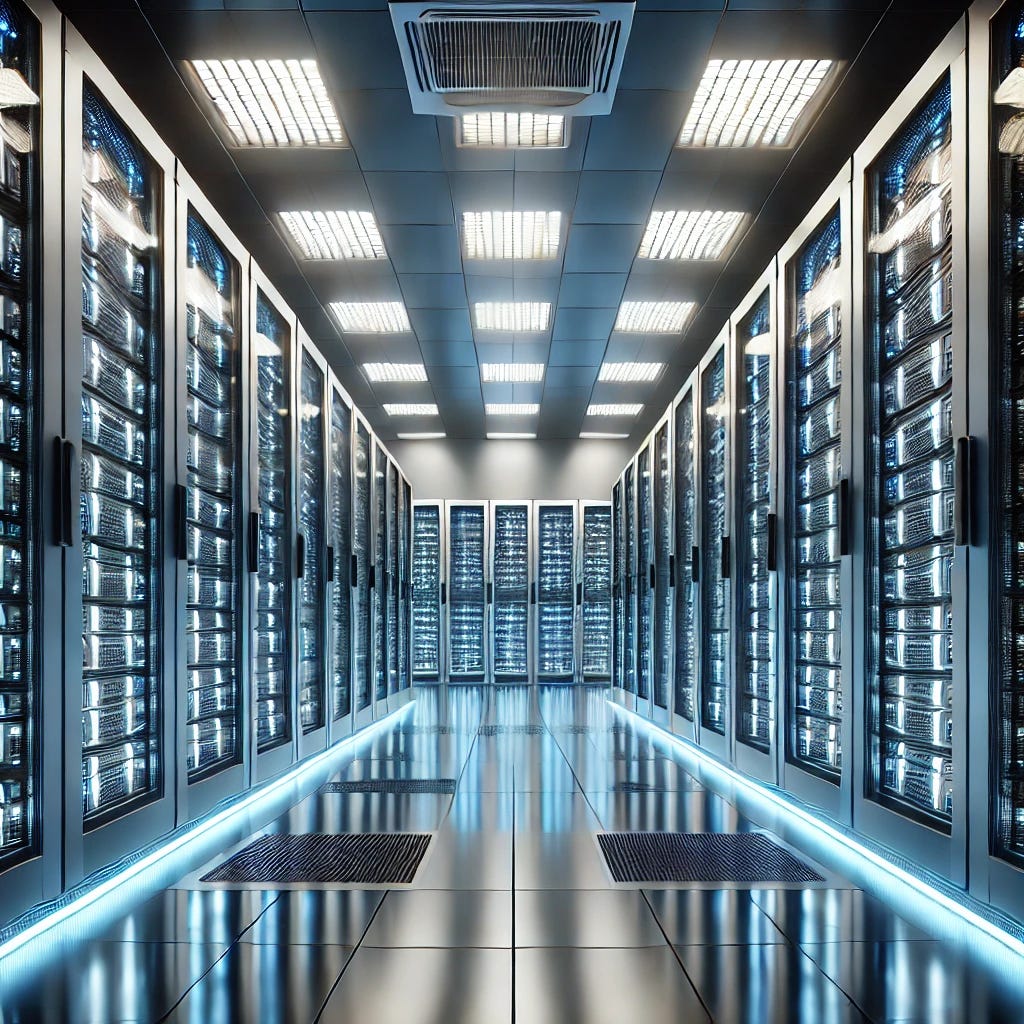

Artifacts in an AI image can sometimes tell us whether the image is “real” or “fake”, although we can’t count on this lasting much longer. AI programs can already fabricate highly realistic images of human faces, as well as more elaborate “deepfakes” with sound and video. These are now so realistic and deceptive that some government agencies have called them a threat to national security.
Paint
As part of the same research project, I also came upon a website called the heart thrills - there is beauty all around us, devoted to the photography and writing of Abellio (a pseudonym).
One of Abellio’s photo essays is devoted to the theme of dark Satanic Mills , an expression introduced into English by the poet and artist William Blake. The article on is based entirely on paintings from the nineteenth and twentieth centuries. These online images are digital in the same sense as the AI data center, but since they are photographs of physical objects in museums and public galleries, they have a documented provenance. The institutions that publish such images are implicitly endorsing their authenticity.
Most of the paintings in Abellio’s article are in UK museums, and accessible through Art UK. We could think of this as “multi-factor authentication”, an idea we’ll come back to later.
The paintings in the article show a wide range of attitudes and perspectives.
The earlier paintings tend to show human workers in a state of near servitude to the work: pouring out molten metal, or hammering red-hot objects into shapes. Either that, or they show the mills themselves as imposing - almost majestic - human creations.
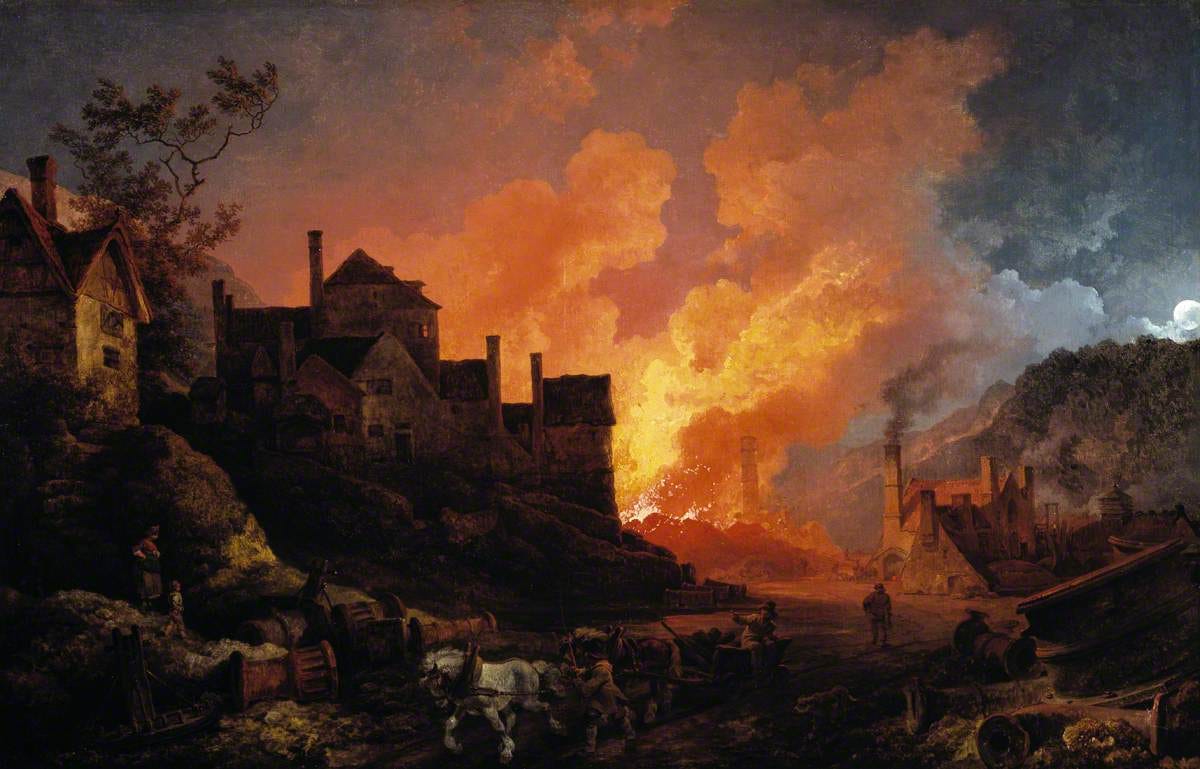
Coalbrookdale by Night (1801) by Philip James de Loutherbourg (below) was painted around the time that Blake was writing. This is fire and brimstone in actual life.
In contrast, Rolling Mill, Avesta, Sheffield (1990) by M. Lawrance shows the steelmaking process almost two centuries later. It isn’t obviously “dark” or “Satanic”, and Lawrance (as the artist) might not have seen the mill that way at all.
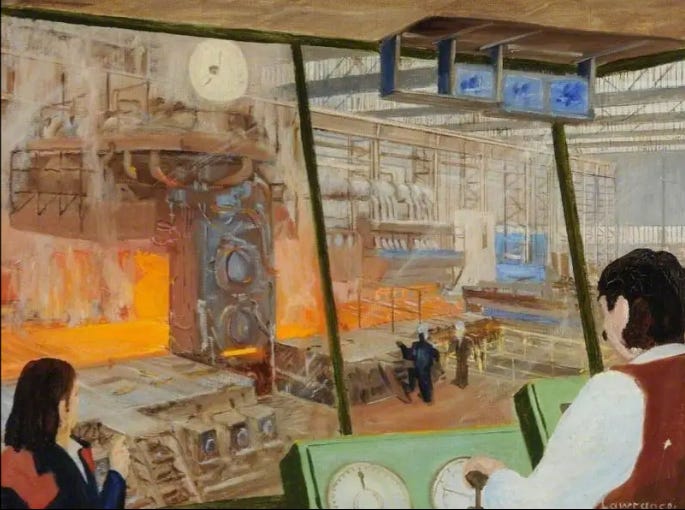
Except that the mill has become banal. The workers are faceless. The controls look primitive against the size and sophistication of the machinery. The colors are muted, and the details of the equipment are implied as opposed to being rendered explicitly. Intentionally or not, we are looking at a different kind of powerlessness and servitude.
From Abellio’s series of artistic impressions on the single theme of dark Satanic Mills, we might arrive at Hannah Arendt’s banality of evil, a modern concept that we can apply (with care) to other times and places.
Presence
Now let’s look at the details in Rolling Mill. The machines here are no more precise than the machines in the AI image we looked at earlier. In fact, if all we had to look at were photographs of paintings, we might not be able to distinguish them from AI fabrications.
What we need to feel confident in a collection of pictures and words is the presence of the artists and writers, along with those who selected and arranged the works.
For example, Philip James de Loutherbourg, whose painting Coalbrookdale by Night appears earlier in this article, was not just a painter, but also a creator of theatrical sets and special effects (which by the late 1700’s were surprisingly advanced). Truth for the theatre audience is not quite the same as truth for the scientific observer, but audiences are quick to reject works that don’t seem “true” to the human experience. Even Theatre of the Absurd must be true to something that the audience can recognize, e.g. we’re trapped in absurdity but we can still react to what we find around us. Works like Coalbrookdale by Night can be emotionally true even they might not be visually true.
De Loutherbourg has been dead for over two centuries, so his presence has to be mediated by people and things: the physical painting, the museum and its curators, all that has been written and said about him over the years, other works by him and his contemporaries, and so on.
If we can imagine a process for confirming the mediated presence of a painter and a curator, we can imagine a similar process for digital assets (pictures, text, music, video, programs, data, etc.). Most of the technology needed for this has already been developed in the context of digital rights management. The main difference lies in the point of view we have to take.
Forgery in art is widespread. If we think of AI fabrications as a kind of forgery, we will be mentally prepared to deal with them.
Here are some links I got from googling “forgery art” (without the quotes). At first I felt amazed, but then I realized that anything worth paying for was worth forging.
Famous Art Forgeries (Sotheby’s Institute of Art)
What if every artwork you’ve ever seen is a fake? (Guardian article)
The King of Forgery: David Henty. Publicity material for a show at The Pilgrim, a London hotel.
Art collection in ancient Rome (Wikipedia)
And the moral of the story is…
We should put our trust in paint, not because a physical medium is inherently more trustworthy than a digital medium, but because we have thousands of years of experience in detecting forgeries.
Photographs of painted works are better than the painted work itself. Very few of us could stand in front of any painting and state with authority that it was real. We know that curators and provenance are important.
If we brought that same attitude to the images we see online, we’d probably be better off.
And practically, since I called this article “a report from the field”, we can use sources like ArtUK as a source of images for our writing projects, instead of mindlessly going to Google Images.
ArtUK has united a million artworks from 3,500 institutions – museums, libraries, town halls, hospitals – as well as public art such as sculptures and murals. Many of the images are in the public domain or available under the Creative Commons license, and academic presentations usually count as “fair use”.
Subscribers to my Andrew Milne substack can expect to see more artwork in my future articles.
Nice work Andrew! Between these paintings and your description, it took me back to my days of working in the Teck Metals Smelter and Refinery in Trail. I spent years working in scenes quite similar to those.